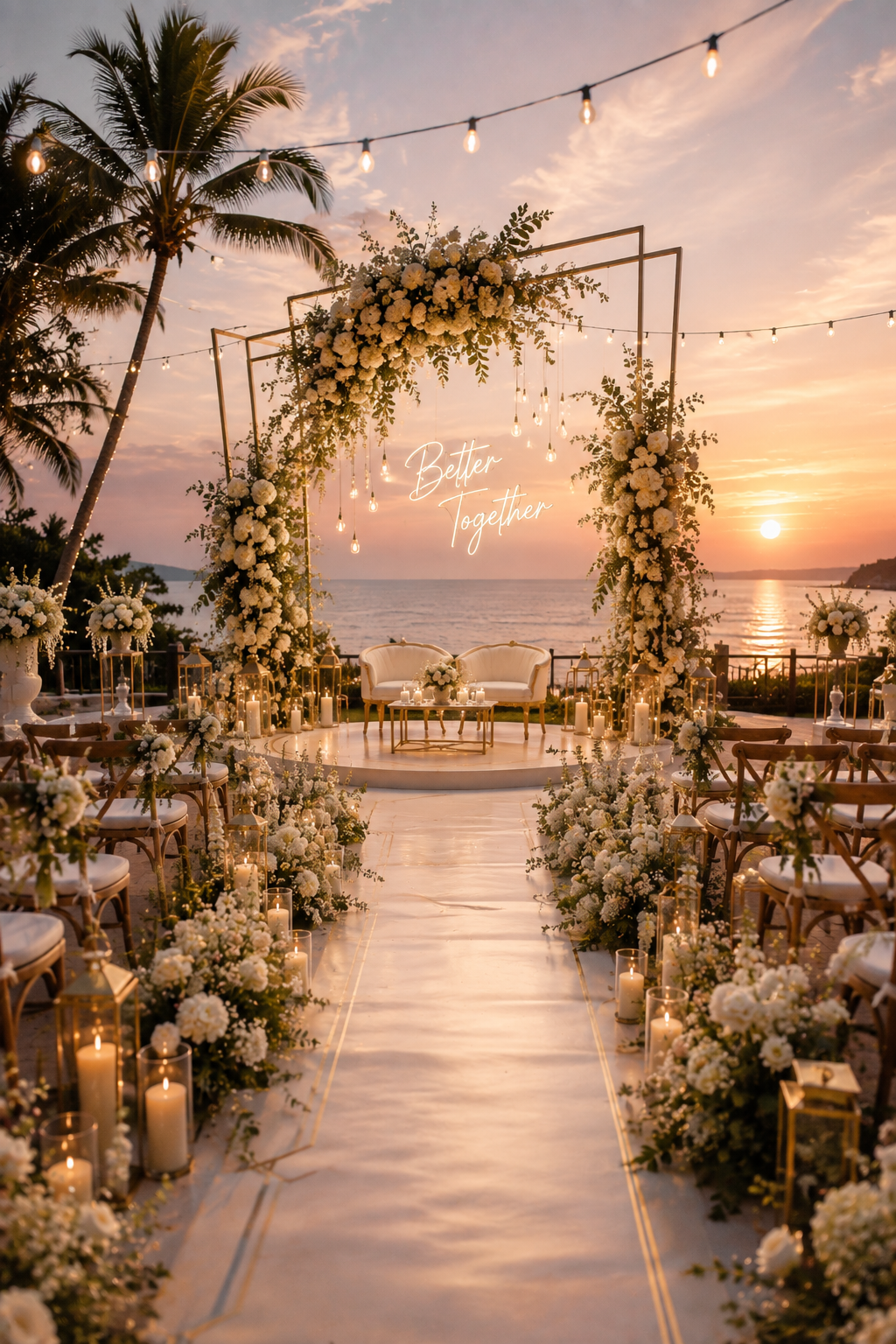
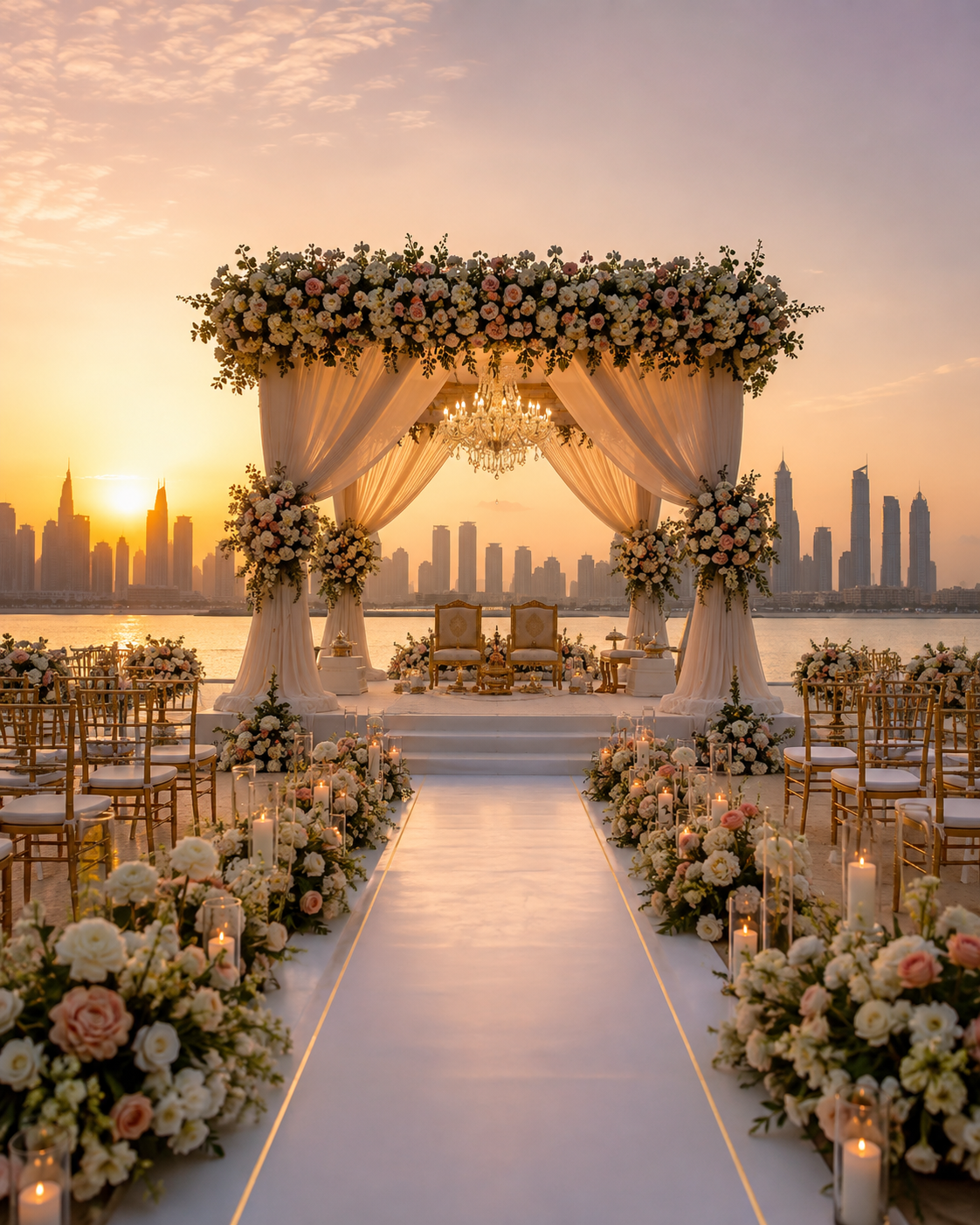
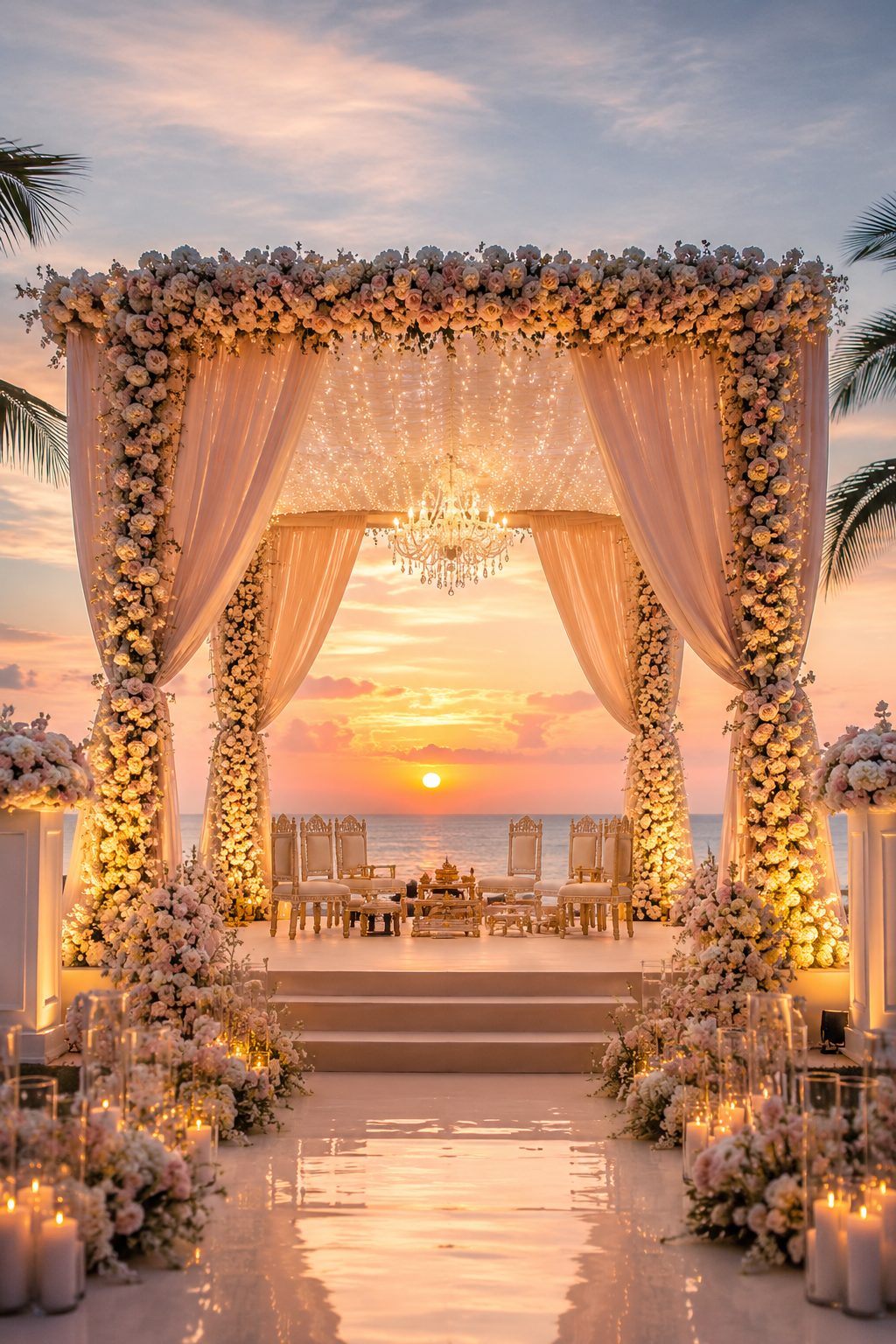
Venue is the decision that constrains every other decision. It fixes your guest ceiling, your setup window, your supplier options and – through ceiling height, floor area and access – what your décor budget can physically buy. Most couples choose a venue on atmosphere and price, then discover the constraints during design. This guide inverts that: it covers what to check before you sign, framed around what actually gets built in the room on the day.
Start with guest count and floor plan, not the photographs
A venue’s stated capacity is almost always its maximum theatre-style capacity, not its comfortable seated-dinner-with-a-dance-floor capacity. Those two numbers can differ by a third. Before you view anything, fix three figures: your realistic guest count, whether you need a dance floor, and whether you want a stage.
Then ask every venue for a floor plan showing a seated layout at your number, with the dance floor and stage marked. If they cannot produce one, that is information. As a working reference, our décor packages are built for up to 100 guests, with a 5m x 5m dance floor from the Signature Edit upward and stage footprints from 2.4m x 3.6m to 3.6m x 7.2m – those dimensions have to fit alongside your tables, not instead of them. If your guest list sits well below 100, read small wedding packages in Dubai before you commit to a large room.
Venue types in Dubai and what each one means for your setup
- Hotel ballrooms. The most predictable option: climate control, in-house catering, service lifts, back-of-house access and staff who run weddings weekly. Constraints are commercial rather than physical – minimum spend, F&B minimums, corkage, and often a preferred or mandatory supplier list.
- Beach and waterfront venues. Strong daylight and sunset photography, and the natural home for texture-led styling. Practical constraints are real: wind loading on backdrops and signage, sand or decking under structures, power distance and a much tighter weather contingency.
- Garden and outdoor terrace venues. Excellent for daytime and shoulder-season evenings. Check shade, ground level for a dance floor, and whether the licensed area is the one you actually want to use.
- Private villas and homes. Maximum control and privacy; maximum logistics. Everything arrives – power, furniture, catering, staff, sanitation. Budget for infrastructure that a hotel would have included.
- Marquees and blank-canvas spaces. The most design freedom, since nothing in the room competes with your palette. Also the most expensive route to a finished look, because the room contributes nothing.
- Restaurants and private dining rooms. Efficient for genuinely small guest counts, but usually limit both décor installation and setup time.
Indoor or outdoor: season, timing and the contingency question
Dubai’s outdoor wedding season is defined by heat and humidity, which narrows comfortable outdoor evening events to the cooler months and makes shoulder-season dates the most contested in the calendar. Two consequences follow. First, if your date sits in the warm months, an indoor venue is not a compromise – it is the design decision, and your budget is better spent on lighting and structure than on fighting the climate. Second, if you are outdoors, ask what the wet-weather and high-wind plan is, where it is, how many guests it holds, and by what time the call has to be made.
Ask the timing questions too: what time the space is released to suppliers, whether an earlier event is scheduled the same day, and what the noise curfew is. A late release compresses the setup window and can force a smaller build than the one you paid for.
The questions couples forget to ask
- What time can suppliers load in, and what time must takedown be complete?
- What is the ceiling height, and are there fixed fittings above the stage or backdrop position?
- How do large items reach the room – service lift dimensions, door widths, stairs, distance from the loading bay?
- Is there a preferred supplier list, and is it mandatory or advisory?
- If we bring an external décor supplier, is there a surcharge, and what insurance or documentation do you require?
- What power is available at the stage, dance floor and DJ position?
- Is another event running the same day in an adjacent space?
- What is included in the hire fee – tables, chairs, linen, basic lighting – and what is charged separately?
- What is the minimum spend, and does it include or exclude service charge and VAT?
- Who is the venue’s on-the-day contact, and when are they on site?
Questions four and five decide whether you can use an independent décor partner at all. Ask them on the first call, not after the deposit. Our guide to choosing a wedding planner in Dubai covers the equivalent question set for suppliers.
External supplier policies and décor restrictions
Venue policies fall into three broad categories. Open venues allow any licensed supplier, sometimes with a small access fee and proof of insurance. Preferred-list venues allow externals but charge a surcharge, or require sign-off. Closed venues require you to use their in-house team, which effectively removes theme choice from your hands.
Beyond who can work there, check what can be installed: whether anything may be fixed to walls, floors or ceilings; whether open flame or candles are permitted; whether confetti, petals or sparklers are allowed; and whether rigging points exist. These rules decide which backdrop and signage formats are buildable and which are not.
How venue choice changes your décor budget
Two venues at the same hire price can produce a five-figure difference in the cost of a finished room. Rooms with strong existing character need less décor and benefit from a restrained palette. Blank rooms need structure, lighting and floor treatment before they read as a wedding at all. Long or awkwardly shaped rooms need more centrepieces and often a second focal point. Outdoor spaces need weighted, wind-tolerant structures and their own power and lighting.
This is why venue and décor should be scoped together rather than sequentially. A fixed-price package makes this easier to control, because the build is defined before you walk into a viewing – see our wedding packages in Dubai, the full inclusion comparison across all three tiers, or why packages beat vendor-by-vendor booking for the reasoning. For the wider budget picture, the 2026 Dubai wedding cost breakdown covers where money goes outside décor.
Venue shortlist checklist
Take this to every viewing and complete it before you leave. Three completed sheets are worth more than ten viewings.
| Check | What to record |
| Seated capacity with dance floor | Number, confirmed against a floor plan – not the brochure figure |
| Setup window | Supplier access time and takedown deadline, in writing |
| Ceiling height and fixtures | Height in metres; anything fixed above the stage or backdrop line |
| Access route | Lift dimensions, door widths, distance from loading bay |
| External supplier policy | Open, preferred-list or closed; surcharge; insurance requirements |
| Installation restrictions | Fixings, open flame, confetti, rigging points |
| Power | Outlet positions and capacity at stage, dance floor and DJ position |
| Weather contingency | Indoor alternative, its capacity, and the decision deadline |
| Total commercial position | Hire fee, minimum spend, service charge, VAT, what is included |
| Same-day events | Any adjacent or preceding event, and shared access implications |
Venue first or planner first?
Either order can work, but they should overlap. Booking a venue with no idea of your décor scope risks a room your budget cannot fill, or supplier restrictions that block the look you wanted. Booking décor with no venue risks a build that will not fit or cannot be installed in the available window.
The practical sequence: set your guest count and budget, shortlist three venues, check supplier policy and setup windows at each, then confirm your décor scope against the shortlist before signing. If you are planning from outside the UAE, this sequence matters more, not less – the destination wedding planner in Dubai service exists to run viewings, checks and coordination on your behalf. The complete Dubai wedding planning checklist and timeline shows where venue confirmation sits against every other milestone, and once your venue is fixed, choosing a décor theme is the next decision.
Frequently asked questions
When should I book a wedding venue in Dubai?
For cooler-season dates, as early as you can – those dates are the most contested in the calendar and go furthest in advance. Warm-month and weekday dates typically stay available considerably longer.
Can I bring my own décor supplier to a Dubai wedding venue?
It depends on the venue. Some allow any licensed supplier, some charge an external supplier surcharge, and some require their in-house team. Confirm the policy in writing before paying a deposit, because it determines whether you can choose your own theme and build.
What size venue do I need for 100 guests?
You need a room whose seated capacity is 100 with the dance floor and stage already accounted for in the layout. Ask for a floor plan at your exact number rather than relying on a headline capacity figure.
Are outdoor weddings practical in Dubai?
In the cooler months, yes, and they are among the most striking options available. In the warm months, guest comfort and floral condition both suffer, and an indoor venue usually produces a better result for the same spend.
Does I Do Weddings provide the venue?
Our packages cover décor, structures, styling, lighting from the Signature Edit upward, logistics and setup – venue hire and catering are contracted separately with the venue. See the packages page for exactly what each tier includes, or get in touch with your venue shortlist and we will tell you what is buildable in each.